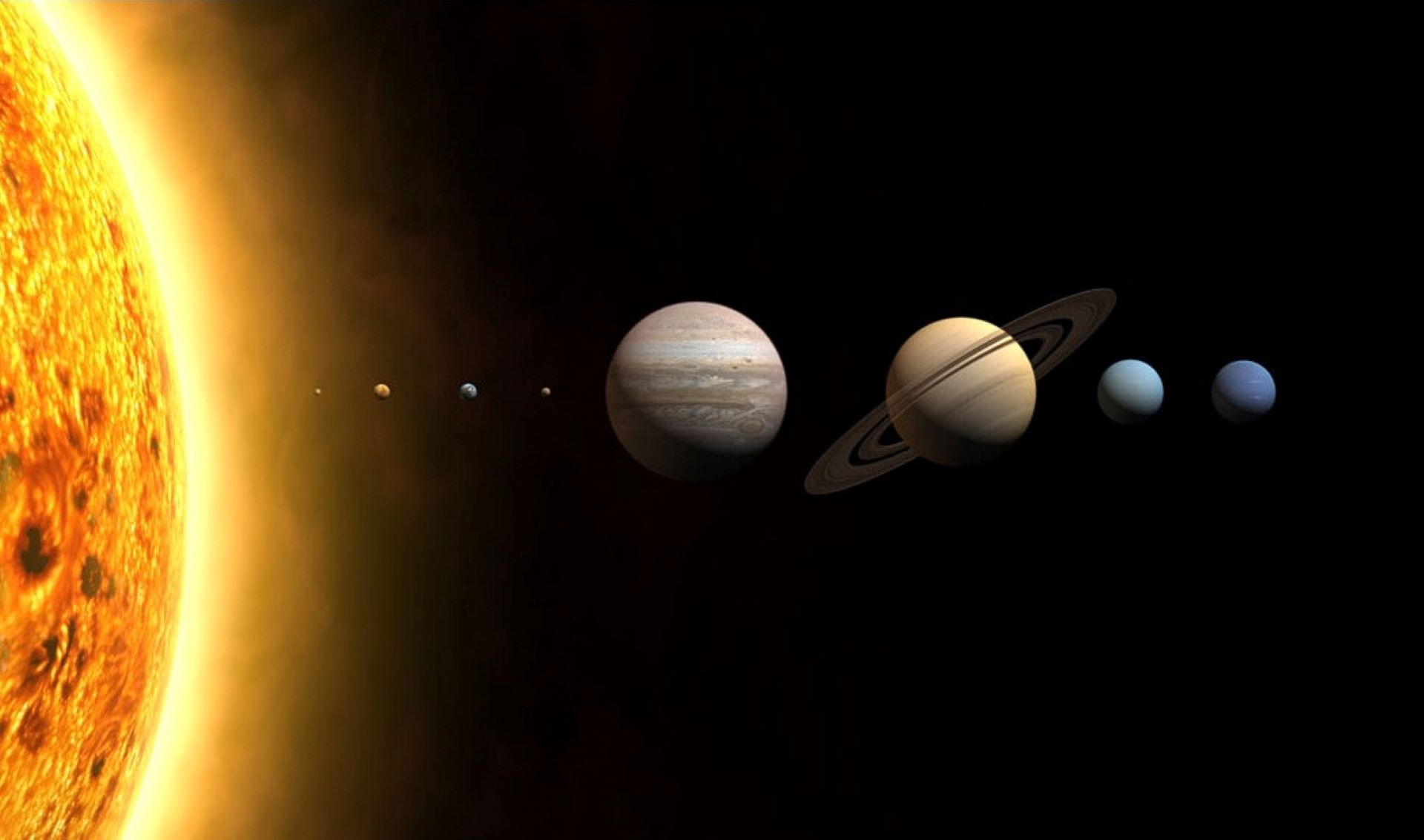

Outer Planets 1
Overview
Telescopic observations were the first step:
- The Italian Galileo Galilei discovered the moons of Jupiter in 1610.
- The Dutchman Christiaan Huygens recognized the rings of Saturn in 1655.
- The Briton William Herschel discovered Uranus by chance in 1781. This was a groundbreaking event because Uranus was invisible to the naked eye. Mercury, Venus, Mars, Jupiter, and Saturn have been known to ancient civilizations for thousands of years because they are visible to the naked eye.
- The discovery of Neptune is a remarkable story in which the planet was first mathematically predicted before it was actually observed in 1846. Several astronomers worked together for the first time.
Then come the unmanned probes that perform a fly-by, they deserve our attention and we will start with this:
- With the Pioneer program in the lead.
- Followed by the Voyager program.
Next come the unmanned probes that become an orbiter and target one planet:
- The Galileo probe orbited Jupiter for years from 1995, taking measurements of the atmosphere and studying the moons intensively. You can find a follow-up here.
- The Cassini-Huygens probe studied the system of Saturn, its rings and moons from 2004 onwards. Including landing the Huygens probe on the moon Titan. A beautiful story for which we will certainly take our time.
And the exploration is still going on. There is the planned future mission to the icy Jupiter’s moon Europa. A beautiful story that has yet to be written, but here is a foretaste:
- NASA’s Europa Clipper probe has the main objective of studying Jupiter’s moon Europa in detail and investigating whether there are conditions below its icy surface that could be suitable for life.
- The mission, launched in October 2024 and scheduled to arrive at Jupiter in 2030, will orbit Jupiter and fly by Europa 49 times over the course of about 3.5 years.
- The main goal is to confirm and characterize the saltwater ocean that scientists suspect lies beneath Europa’s thick icy crust. This ocean is estimated to contain twice as much water as all the oceans on Earth combined.
- The probe will not directly search for extraterrestrial life itself, but will examine conditions to determine whether the moon has the necessary ingredients (water, energy sources, proper chemical elements) to support life as we know it.
- The Clipper will map the thickness and structure of the ice sheet and study the interaction between the crust and the ocean below.
- The Clipper is equipped with nine scientific instruments to collect detailed data during the many fly-bys. He will conduct detailed research to assess whether Europa is a habitable environment beyond Earth.
The mission of the Pioneers and the Voyagers
The Pioneer probes (Pioneer 10 and 11) are the direct precursors of the Voyager probes (Voyager 1 and 2). These four space probes laid the foundation for the exploration of the outer parts of our solar system (say the outer planets) and the collection of data about interstellar space.
The Pioneer missions were launched in 1972 (Pioneer 10) and 1973 (Pioneer 11). They were the first to successfully travel through the asteroid belt and make close-up observations of Jupiter and Saturn. Their findings and technological successes provided a crucial basis for the later, more advanced Voyager missions.
The Voyager probes, both launched in 1977, were equipped with more advanced instruments and cameras than the Pioneers. This allowed them to send back more detailed data and images, and also visit Uranus and Neptune, which was not the case with the Pioneer probes:
- So the Voyager project built on the success of the Pioneer project.
- And in the early 21st century, the Cassini-Huygens mission will build on the Voyager success.
Both the Pioneers and the Voyagers are outside our solar system and have now entered interstellar space. At the moment, the four probes have only traveled a few thousandths of a light-year.
However, the Voyager probes have a higher speed and they have caught up with the Pioneers. The Voyager probes were able to reach that higher speed:
- Thanks to gravitational pendulums past Jupiter and Saturn for Voyager 1. These two gravitational pendulums were more direct at shorter distances and gave a higher acceleration.
- Thanks to gravitational swings past Jupiter and Saturn and also past Uranus and Neptune for Voyager 2. These four gravitational pendulums were less direct at longer distances and gave a lower acceleration.
The Pioneers were launched earlier, they are slower because they made less use of the gravity pendulums:
- Voyager 1 overtook Pioneer 11 in 1981 and overtook Pioneer 10 in 1998. For example, on February 17, 1998, Voyager 1 became the most distant human-made object and it also moves away from the Sun at the highest speed. It will therefore remain the most distant object for the time being. Voyager 1 left the heliosphere in August 2013, and was the first human-made object to reach interstellar space.
- Voyager 2 overtook Pioneer 11 in 1988 and overtook Pioneer 10 in 2023. Thus, Voyager 2 became the second most distant object made by humans.
Voyager 2 will never catch up with Voyager 1, the opposite has happened. Voyager 1 overtook Voyager 2 in 1977, which is in fact shortly after the launch of both probes. Now they are each flying in their own direction.
Although Voyager 2 was launched earlier, Voyager 1 was steered on a faster, more direct course. Better gravitational pendulums were used that eventually gave it a higher final velocity (see above). So the distance between the Voyager probes is constantly increasing:
- Voyager 1 is therefore moving faster at about 17 km/s or 61,200 km/h. This corresponds to about 0.00567 % of the speed of light.
- Voyager 2 flies at about 15 km/s or 54,000 km/h. This corresponds to about 0.00501% of the speed of light.
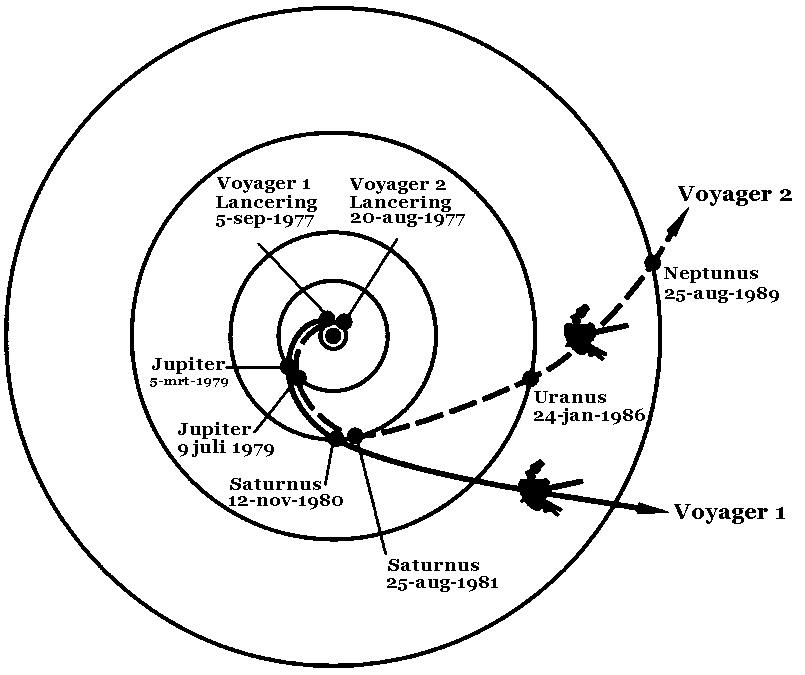
This illustration can be seen on the Wikipedia website.

Comments