
Outer Planets 2
The Pioneers in a nutshell
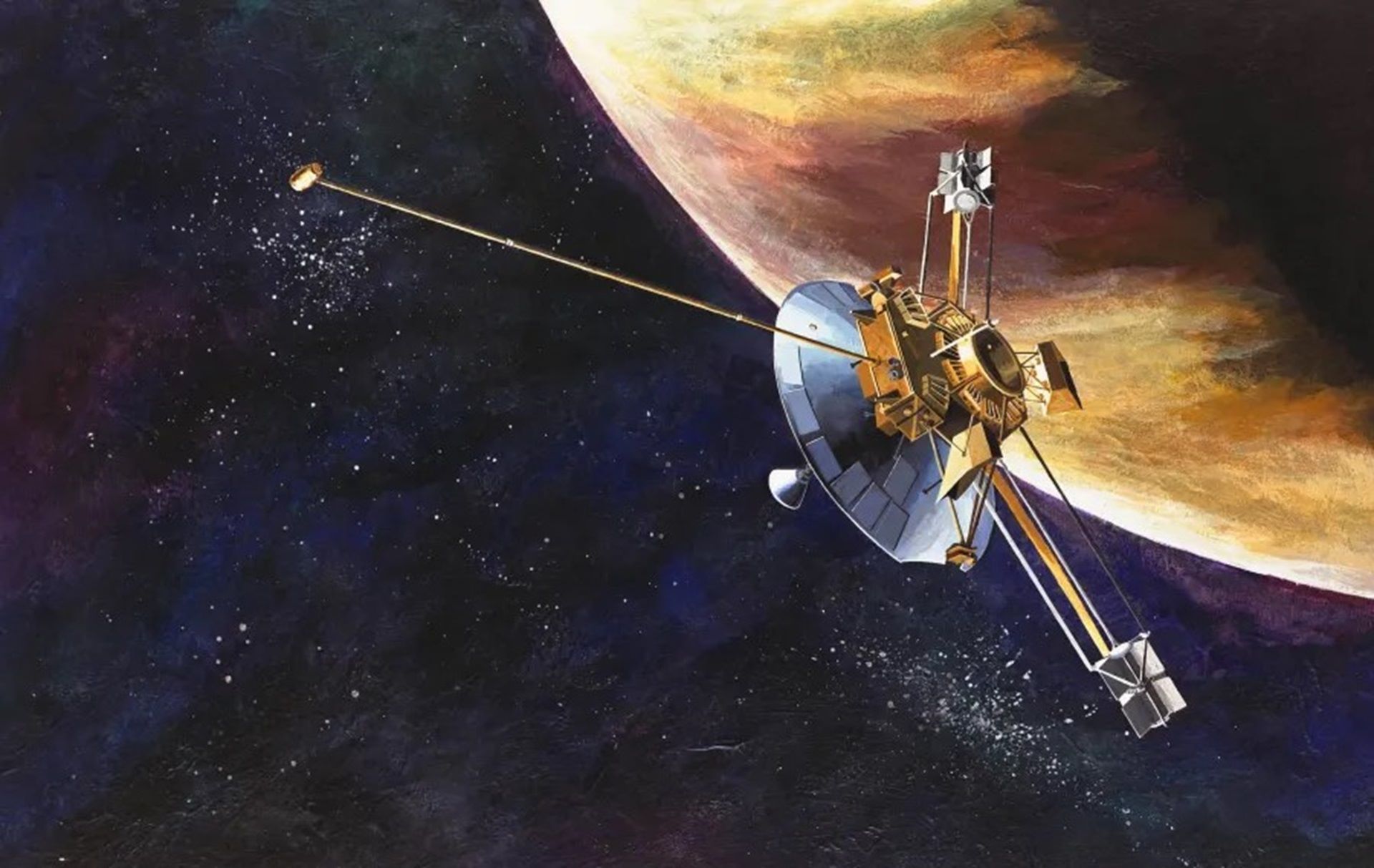
The Pioneers were launched in 1972 (Pioneer 10) and 1973 (Pioneer 11).
Originally, they were referred to as Pioneer F and Pioneer G before being given the names Pioneer 10 and Pioneer 11, respectively. They served as pathfinders for the later and more technically advanced Voyager missions, testing the routes and conditions for future unmanned exploration.
They were the first to successfully travel through the dangerous asteroid belt, demonstrating that this was possible for future missions.
They made close-up observations of Jupiter and Saturn.
The probes provided valuable data on the solar wind and the range of the magnetic field around the Sun, the so-called heliosphere, at great distances.
There has been no contact with the probes for a long time, but their positions are still being calculated. Both probes are essentially ghost ships that are quietly traveling through space, their operational missions have ended and they can no longer be detected.
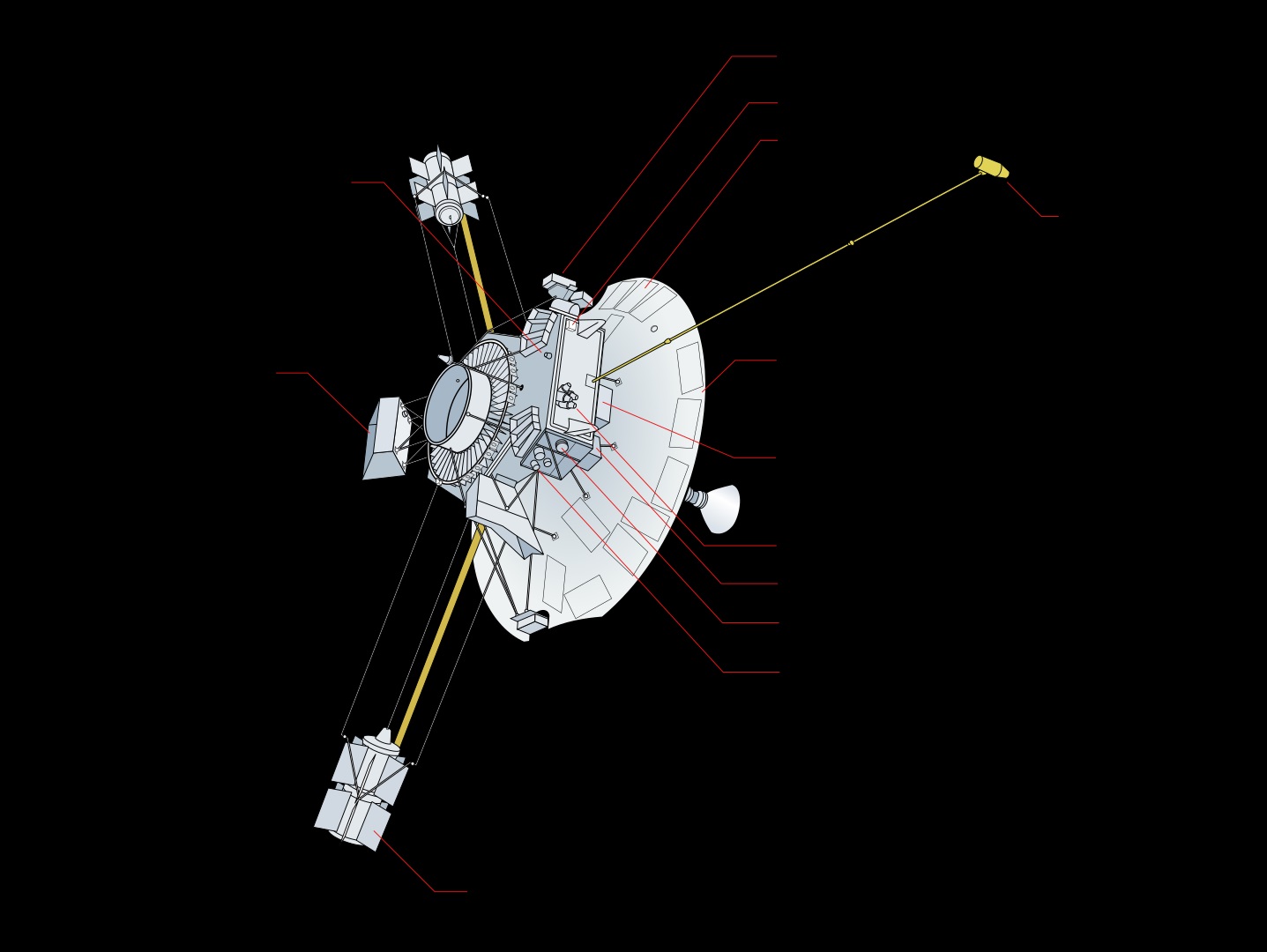
This illustration can be seen on the Wikipedia website.
Pioneer 10
Is heading in the general direction of the red giant star Aldebaran, in the constellation Taurus (Taurus).
It is expected to be near this star in about two million years.
As of July 2025, the distance is estimated to be about 20.9 billion kilometers (139.7 AU) from Earth.
The last, very weak signal from Pioneer 10 was received on January 23, 2003. Further attempts at contact in 2006 were unsuccessful, and the mission has officially ended. The power source (radioisotope thermoelectric generator, RTG) is no longer powerful enough for data transfer.
Pioneer 11
The probe will travel in the direction of the constellation Scutum, in the direction of the star Lambda Aquilae, which it will approach in about four million years.
As of June 2024, the distance was estimated to be about 16.9 billion kilometers from Earth.
The last contact with Pioneer 11 was in November 1995. Due to a change in the orientation of the probe and the decreasing power of the power source, the antenna could no longer be pointed at the Earth, making communication impossible.
The Voyagers in a nutshell
On August 20, 1977, Voyager 2 was launched from Cape Canaveral. On September 5, 1977, the launch of Voyager 1 followed. This mission was created to take advantage of the rare mutual position of the four large outer planets in the late 1970s and 1980s: they were aligned at the time. This once-in-a-175-year situation made it possible to reach the planets Jupiter, Saturn, Uranus and Neptune with a minimum of fuel and travel time. NASA’s Voyager mission is the largest, the most ambitious and the most iconic space mission ever. Although Voyager 1 was launched later, it reached both Jupiter and Saturn first, because it followed a shorter route.
These probes will soon become ghost ships that travel silently through space, their operational missions have ended and they will no longer be detectable.
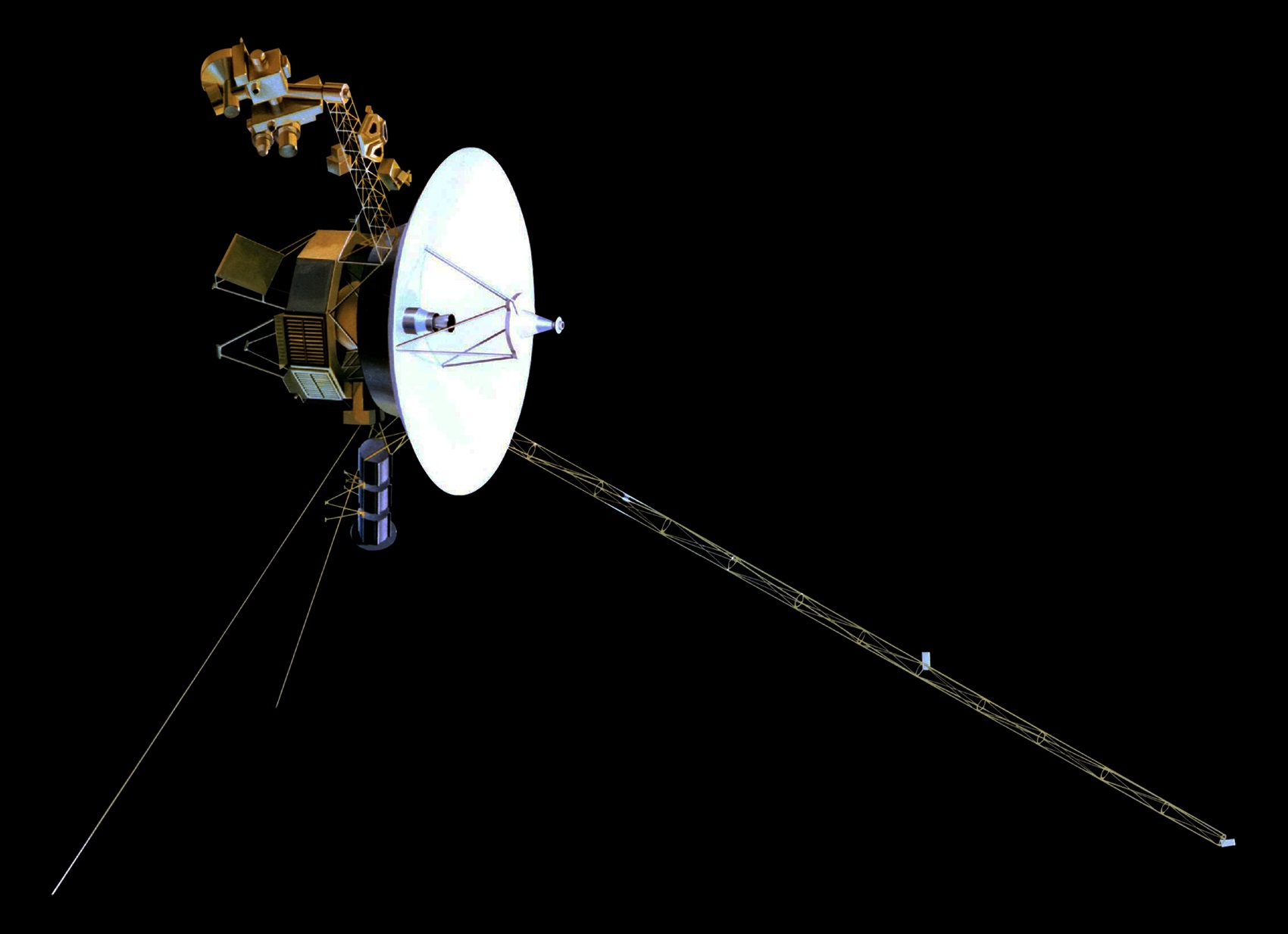
This illustration can be seen on the Wikipedia website.
The merit of Voyager 1
This one is huge and versatile.
He explored the gas giants Jupiter and Saturn.
It provided the first detailed close-up images and data of Jupiter and Saturn, including their moons and rings. These data have fundamentally changed our knowledge of the outer parts of our solar system.
It is the first man-made object to have reached interstellar space and is the farthest from Earth and the Sun.
He continues to collect valuable data about the interstellar medium.
NASA is still receiving data from the probe:
- Of the eleven instruments on board, four were still operational in 2023.
- After a period of technical problems that began in November 2023, during which the probe sent back unreadable “gibberish”, NASA engineers have successfully repaired and restored the communication system.
- Since April 2024, Voyager 1 has been sending useful technical and scientific data back to Earth.
- Voyager 1 is currently more than 24 billion kilometers away from Earth.
- It takes about 22.5 hours for a signal from Earth to reach the probe, and another 22.5 hours for an answer to return. Communication is therefore very delayed.
- Although the probe’s power supply is decreasing, the mission is still active and the connection is expected to remain in place for several more years (perhaps until about 2030).
He took the iconic photo “Pale Blue Dot” of the Earth in 1990, which had a profound cultural and philosophical impact by highlighting the insignificance of our planet.
Together with Voyager 2, it forms the longest-running space mission of all time. He has been working for almost 50 years, which shows remarkable technical durability.
The merit of Voyager 2
This one is also huge and versatile.
Successively, Voyager 2 passed Jupiter (July 9, 1979), Saturn (August 25, 1981), Uranus (January 24, 1986) and Neptune (August 25, 1989). For now, Voyager 2 is the only space probe to have visited these last two ice giants. Voyager 2 has returned about 17,000 new photos of Jupiter and its moons during its passage. Together with the images from Voyager 1 (which took almost 19,000 images), the two probes took a total of more than 33,000 images of the Jupiter system.
The photos from Voyager 2 were of great interest because they complemented the data from Voyager 1 and provided an almost uninterrupted view of Jupiter’s atmosphere over a six-month period, allowing scientists to observe changes in the Great Red Spot and other atmospheric features. That Great Red Spot on Jupiter was photographed and studied. It is a gigantic storm, twice the size of the Earth, which has been raging for centuries with wind speeds of up to 435 km/h.
For example, Voyager 2 took close-up images of Jupiter’s moons, which provided new insights into their surfaces:
- On the moon Europa, a subsurface ocean was found under a kilometer thick layer of ice. The ocean is estimated to contain more than twice as much salt water as all the oceans on Earth combined. Europa is considered one of the most promising places in our solar system to find extraterrestrial life.
- Active volcanism was found on the moon Io. This moon orbits very close to its parent planet. Jupiter is constantly kneading Io, and that’s how Io gets its heat from Tidal Heating. This is tidal heating due to the gravity of the immense mother planet Jupiter.
- Three new, small moons were discovered and the thin ring system around Jupiter, not visible from Earth.
He discovered that Saturn’s rings are much more complex than previously thought. There is a curious interaction between the rings and some of Saturn’s many moons. Seven new moons were discovered, and the bizarre hexagonal cloud formation, twice the size of Earth, at Saturn’s north pole was examined.
During its visit to Uranus, Voyager 2 discovered eleven new moons and two new rings. Data was collected about the unique magnetic field of the planet. A striking feature of Uranus is its obliquity or axis tilt. The planet is completely on its side, the poles are horizontal and the rings and moons are vertical.
Finally, he also visited Neptune, which appears as a blue ice giant. Four new rings and six new moons were discovered. On the moon Triton, where there is an average temperature of -200 Kelvin, geyser activity was observed. Dark spots were seen, which then disappeared after some time and remain unexplained to this day. By using the gravitational pendulum around Neptune, the mass could be calculated fairly accurately and is 17.15 times the mass of the Earth. Suddenly, all the irregularities in the orbits of the most distant planets could be explained. This put an end to speculation about a possible ninth planet.
Meanwhile, Voyager 2 has also left the orbit of the dwarf planet Pluto far behind and left the heliosphere on November 5, 2018.
Voyager 2’s power supply is getting weaker and weaker, but there is still a connection to Earth:
- Communication is mainly provided by the large Deep Space Station 43 antenna in Canberra, Australia, as the probe’s southern location requires it.
- Due to the enormous distance (currently more than 20 billion kilometers), it takes about 19 hours and 20 minutes for a signal from Earth to reach the probe, and that long for the answer to return.
- There were temporary communication issues in August 2023, but these have been fully resolved and contact has been restored.
- To make the mission last as long as possible, NASA recently (around March 2025) turned off one of Voyager 2’s science instruments to save energy.
- It is expected that the probe can remain operational until at least 2026, possibly longer, depending on the remaining energy.


Comments